Showing posts with label Point2 Homes. Show all posts

Tuesday, October 09, 2007

The Power of the Long Tail

This Post is mainly to respond to some questions Point2 users have about long tail search in the real estate vertical, and about a particular stat we've quoted: "60% of local homes searches have a neighborhood component to them." The comment came from a Google official in a slide show presentation on Search and the Real Estate Vertical.

The context is that of all the search conducted for real estate, homes for sale, or property (i.e. the real estate vertical), 60% of the search terms contained a neighborhood component. This is also called the longtail of search, which constitues more narrowly defined search terms. While "San Francisco real estate" represents a broad search, an example of a longtail search with a neighborhood component would be: "Nob Hill San Francisco real estate". I don't have the specific Powerpoint or research that were presented,nor do I want to misrepresent what they discussed. But I can demonstrate what this means, leveraging research we conducted at Point2.

If you are not Google and you want to measure the amount of search volume, you need to have a site that generates a lot of long tail traffic. Plus, you need to rank at the top for the broad terms, because they drive the most traffic. This way you are likely to have a good representation of the relative size of long tail traffic vs. broad search traffic.

We used Point2 Homes and chose the city of Ottawa Canada because Point2 Homes ranks well for top search terms used by consumers, like "Ottawa real estate" and "Ottawa homes for sale." Of course Point2 Homes represents a good platform for this test because it is optimized to generate a large set of long search traffic.

Over a 2 day period, Point2 Homes generated 547 visits to Ottawa and it's neighborhood level pages. Of those 547 searches, 259 or 47% contained an Ottawa neighborhood name, proving that consumers use neighborhood terms when searching for real estate in this area.

The ugly screen shot above shows you a piece of the working spreadsheet. Where the first column lists the keyword term, the second column is simply identifying ones with a neighborhood name. The 3rd column shows the search volume for the keyword term.

We have tested several other Canadian cities and the results are very similar with longtail traffic, generating between 45% and 50% of the visits.

You can see from that screen shot that the first neighborhood searches that we identified include: "homes for rockliffe ottawa," "house for sale ottawa west," "houses for sale glebe ottawa," "condos in the riveria + ottawa" and, "country club village ottawa."

Real estate is very local and while not all areas are the same, the patterns we see across the US are very similar. For this research, we did not use US cities because we do not yet have a good set of cities on Point2 Homes that rank at the top for broad terms.

It's clear that there is a lot of traffic out there in the long tail and thus it's clear that we need to take advantage of that traffic and describe content accurately to match what search engine users type into their search bars.

Share

Sunday, March 25, 2007

The Power of Context

As traffic flows over the Internet, every click is made with purpose and quickly followed with an underlying question, "What's in it for me?". Every page that is clicked to has very little time to answer that question. Every link wanting to be clicked competes with all other links on that page. The content on the page needs to answer the basic question. If a site can not understand the visitor's purpose and answer that basic question, "What's in it for me", the visitor will leave the site. Sites that hold visitors:

1. Understand the purpose of the typical visitor,
2. Answer the question "What's in it for me"

Now, sites that do an exceptional job of holding visitors answer that basic question over and over again by providing more and more relevant content in context. Let's look at an example.

A real estate website that is discussed frequently by Michael Russer is www.cptaction.com. It's an example of a site that does a good job of identifying a clear target audience, military families. The military relocation families visiting this site have unique needs and the site does an excellent job of providing unique context. Visitors are able to view real estate services in the context of those specific needs. Another great example is www.goarmyhomes.com/.

Google has created the most successful ad serving platform in the world with Adsense. There are many reasons for the success of Adsense, but the main driver is Google's ability to display relevant ads to people viewing a web page, be it Adwords ad on Google.com or on another site using Adsense. The ads have context and click thrus are maximized.

A website that can present better content in better context will create a remarkable experience. Point2 has thought a lot about context. How many real estate agent directory websites have you been to? There are so many of them out there and how many provide any meaningful experience for the consumer? I haven’t found one. The directories serve real estate agents by providing SEO value, that’s all.

Point2 not only wanted to build a directory that provided SEO value but value to the consumer as well. On Point2 Homes, a drill down agent directory was created that navigated right down to the neighborhood level. If a consumer is browsing an agent directory, what matters to them? Well, from studies like the 2006 NAR Profile of Home Buyers and Sellers we can find relevant feedback that could be used. We can learn that some buyers chose an agent because the agent’s market area was where they wanted to move. One of the values that sellers looked for in an agent was knowledge of local area. So from that, we built a directory where you can find agents, by neighborhood that have listed homes in that neighborhood. The result is that you have a directory where you can search for real estate professionals organized in a more valuable context. The goal is to provide SEO value to members, but to drive traffic to member websites from consumers that find value in the directory.

In order to make a study of context valuable on your website, you have to understand your visitors. Who exactly are they? Where did they come from? What are they looking for? GoArmyHomes.com will not be successful if the traffic it’s attracting is not military relocation families. That seems to be common sense, but just because you build a website on topic, does not mean your traffic will automatically be that category of people. But the formula for success holds if the following will be true.

You drive targeted traffic
And you provide context
Your conversion rates will be higher

A short note I should quickly add to those points, please don’t try and choose the largest category of visitors as possible. Your conversion rates will be higher if you don’t have a lot of competition. The GoArmyHomes.com site will not be as effective if the ‘net’ is flooded with similar sites. What is your target audience?

So the question conclude this post, if you are a real estate professional, how can you provide a better context for your website visitors? How can you organize content on each of your pages to provide better context and engage the user better?

Share

Tuesday, December 05, 2006

An Edgeio Analysis

I read a blog post on the new Edgeio purchase on Transparent RE.com. The writer discusses the purchase of ARES by Edgeio and the possible implications. I have a few comments:

Edgeio is a vertical search engine. It currently works to drive traffic back to the listing source. On the listing example that mentioned, it only links to 1 source - www.point2homes.com (not 3 as suggested). Point2 is the service provider that has syndicated the listing to Edgeio. The listing was inputed by a Keller Williams Agent using Point2 software. In this case, the agent is using a free version of the software so the link back is going to the listing detail view with more information at Point2 Homes. If the agent was paying for a website with Point2, the listing on Edgeio would link directly to the listing agent's website.

I suspect that Edgeio will use the MLS IDX feed to eliminate the duplicate entry problem and syndicate listings for the Broker of Record. The challenge is that the listing will not index as well because the MLS does not gather enough local, search information.

I don't see Edgeio syndicating an entire MLS inventory via the broker's IDX feed (as the writer suggests). It opens up a whole can of worms around a listing broker's ability to control how and where their listing is advertised. Yahoo Real Estate currently uses IDX feeds from Prudential. In the process, they have ostracized the rest of the industry. You can't do that in an industry that is this fragmented, with 1.2 million professionals that spend collectively around $11.9B / year on advertising and promotion.

Share

Wednesday, November 08, 2006

Spotlight Ads Live!

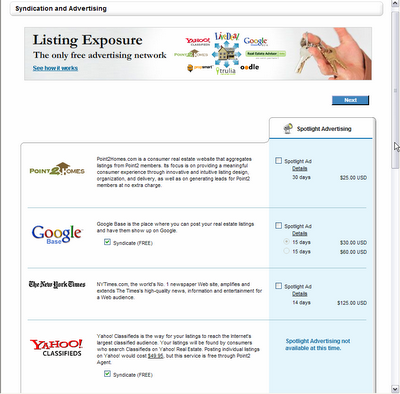
Ok, some of you may have noticed that the Point2 Blogs went live yesterday. Well just a few minutes ago, we lit up spotlight advertising. When you manage or just add a new listing, the syndication page will show you a list of all the sites you can syndicate your listing to for free. Now, you will also see options in the right hand side spotlight add column for enhanced placement.
The 2 partners currently offering spotlight ads are Point2 Homes and Google. You will also see our newest partner, the New York Times where you can showcase your listing for $125 - all from 1 dashboard! Here's a screen shot


Share