Showing posts with label Real Estate Marketing. Show all posts

Monday, May 05, 2008

Trulia Critics - Right or Wrong?

Today Glen Roberts at Inman News reported on a debate that was stirred up by Galen Ward of Estately (there's some link juice Galen...). Galen asked why does Trulia show up in search results above the original source. His answer:

"In this case, two reasons: the original source doesn’t even display the address on the page (dude - MLS rules are stupid, but they usually let you display your own property’s address at least - you gotta fix that!). But the much more common reason is that Trulia blocks Google from following their links."

So I agree the first reason is brutal. The real estate industry needs to help themselves. Some brokers and agent use solutions such as the Point2 where property listing have their own search engine friendly URL that can be indexed (such as this example from Jay Thompson's site).

But the second reason I neither find offensive nor accurate. As Galen explains, Trulia uses 302 redirects that prevents the flow of link juice to the source site. It helps their pages maintain authority. I don't find it offensive because these sort of things are common with any general online advertising arrangement. If you complete a link exchange with another site, you purchase a follow or nofollow link. Nofollows are designed to send traffic, not search authority. Realtor.com has been doing this sort of thing forever, they rank way higher than Trulia, so why the stink now? (see the link to http://www.npreco.com/ from this listing on Realtor.com) So secondly, I don't find the evaluation completely accurate because I don't think it's the main reason Trulia ranks higher. I have a couple of points here:

The NoFollow Reason

Rudy seems to admit SEO is reason for the nofollows. It's debatable in my mind whether or not it would be detrimental for Trulia to link out in their search results. Linking out to relevant sites can help a website's trust. Rudy also states, "Let’s be honest, most broker or agent websites would not rank better than they do currently if we removed the nofollow in the outbound links (99.9% of listings pages have no page rank or page rank 1)". That's true for the most part, but links from main search result pages like Denver (PR 4), would see value - I just couldn't let that one go. But while Galen suggests the redirects are an designed to block PR from flowing to other sites, the specific intent of the method. Rather than a practice to prevent other sites from receiving value, it's design is to help large sites flow page rank to deeper levels in their site hierarchy. By controlling this flow of link juice, Trulia's primary motivation I suggest is to push page rank deeper through their site.

Real Reason's for Truila's Search Success

More importantly, these nofollows (or 302 redirects) are not the main reason for Trulia's search dominance. There's a few big ones in my opinion:

1. First they've done some great marketing and promotion now that's resulted in a PR 7. That's and achievement and not many local sites can top that. Even RE/MAX.com is only a PR 6. This has nothing to do with redirects or nofollows, and everything to do with a lot of buzz and exposure.

2. Secondly, they have great site architecture for SEO. The page titles, content and heading tags all have the right keyword terms. It's consistent whether you are looking for Colorado, Denver or Bear Valley Denver real estate. VERY few real estate practitioners do a good job of this.

3. While there are other reasons, the third and last one I'll mention is that they have a widget strategy - a much more brilliant and interesting thing to talk about than the 302 redirects. Trulia has built several useful widgets that relevant real estate sites like Jay's can use. You'll see at the bottom of the widget there are 2 built in links. One link goes to the Trulia home page, helping out that PR 7. The second link is a deep link into Trulia. Since Jay's site is a Denver real estate site, the Trulia link goes to their Denver page.

So now Trulia has thousands of relevant links form real estate websites linking to their home page and deep linking into their site. Note that there isn't a nofollow on those widget links (of course)! Good for Trulia! It's a brilliant strategy. They have to build tools that add a lot of value (or perceived value) to execute on such a strategy. Also note that they've done some solid business development work and have authoritative sites like RIS Media using their widget's and linking back to Trulia.

If I was a real estate agent or broker, I probably wouldn't use the widget's and give Trulia that link. And if you consider their nofollow policy on their listings and result pages, it's not really a fair link exchange if you're using a widget :-) But my bottom line is - it's all negotiable! If brokers care about SEO for their own site, they can negotiate a removal of the nofollow. If it's not negotiable, a broker doesn't have to send their listings.

Share

Wednesday, April 16, 2008

Real Estate SEO - Franchises Missing the Boat

Well isn’t this blog neglected! To tell you the truth, over the past couple of months, I’ve been writing business plans, grant proposals, research documents, project and technical requirements and I have to say that I haven’t had a lot of gas in tank to write for this blog. I think I have to learn the art of micro posting!

So what has awakened me from my slumber? I was reading an RIS article by Glenn Houck this morning on SEO. After leading the Homegain charge for many years, Glenn certain knows a lot about SEO but he keeps things pretty simply in this article. SEO in real estate really gets me going because so many companies are completely missing the boat. This short article reminded me of a post Joel Burslem made listing his 10 favorite real estate search sites. The new Century 21 Canada site was one of them. I have to admit that I like the look and I like the map search implementation but this site missed the SEO boat totally. Let’s back up a bit because really, why does this matter...

Search engines (google) are like today’s phone books. In the old days, you picked up a phone book, flipped to the yellow pages, found the appropriate category (real estate) and searched through the listed ads. The differences are the following. In a search engine there are too many pages to produce a book. Flipping virtual pages just wouldn’t be practical either so you search by topic rather than flipping to a yellow page topic. So the first important point to make here is that websites need to ‘tell’ a search engine what their topic is. What Century21.ca has done is the equivalent to telling the yellow pages to make a topic called “Century 21” rather than ‘real estate’. In fact, it’s like they’re also trying to say, “we transcend real estate so don’t put us in that category at all.” (it’s the only logical conclusion I can make)

Ok, so on to the second point. With a search engine, it’s like having one big phone book rather than many small local phone books. So for large businesses that have many offerings or many local business offices, they can have an ad or listing for each relevant one. I’ll clarify using Century21.ca again. Not only should they be listed under the term ‘real estate’, but they should have relevant listings for terms like ‘Ontario real estate’ and ‘Toronto real estate’ and ‘Scarborough real estate’. It’s like having many yellow page ads. So building on point 1 – not only do you have to identify the category you should be listed in, but you need to identify other sub categories and make all of your yellow page ads (in this case, web pages) discoverable so they make it into the phone book.

The 3rd point in our comparison is that content in search engines is sorted differently than phone books. Because searching is fundamentally different than flipping through pages AND there is simply too much content out there (or yellow page ads in our metaphor), you can’t sort stuff in a search engine in alphabetical order. So the way a search engine sorts content is by relevance and popularity. If people talk about your business offline, you get word of mouth advertising. If they talk about it online, they link to it. A link is considered a popularity vote as Glenn notes.

A copyright notice at the bottom of Century 21 Canada shows WheretoLive.com Inc. so I assume they were contracted to build the site. If it was 1999 or 2001 I can understand a large corporation missing the SEO opportunity, but in 2008, this stuff should just be common knowledge and standard practice. There’s certainly enough information about SEO published online! Search is the way people find information today and unless a website is generating traffic, it’s a billboard in the middle of nowhere. SEO is not something that some geeky kid jumps in and performs on website. SEO is a philosophy for technical design architecture. Beyond that, SEO principles should permeate a company’s marketing so offline and online efforts all help more people find those yellow page ads.

Search engine optimization may be old news to some people and some may think that it’s a web 1.0 way of thinking. But, it still sits at the core of how we define ourselves in the online world. Because content is organized by the popularity of the documents, it is the most fundamental way we manage our reputation online. When I search for real estate in Canada, not only will I never find the content on Century21.ca, if I was actually looking for their site to show up, I would conclude that they don’t have a high enough reputation (and thus quality of content) for me to bother.

Share

Sunday, December 17, 2006

Why Zillow Will Never be the National MLS

There’s been a lot of discussion around Zillow’s latest announcement and there have been a lot of people asking for Point2’s perspective. This is my personal perspective on the issue and why I’m not that concerned about Zillow adding listings to its portal.

Much of the discussion sparked by Zillow’s announcement has been around the emergence of a national MLS or a portal that will replace the current MLS systems -company that all real estate buyers and sellers will use.

Why I’m not waiting for Zillow to be ‘THE’ place.

The September 2006 monthly internet portal statistics from Realtor.org claims the total traffic to the real estate vertical was over 40 million visits. The list contains 25 portals in the vertical. The highest trafficked portal is Realtor.com with 6.1 million visitors, accounting for roughly 15% of the total. But there are many noticeable exceptions to this list: real estate sites such as Zillow.com, Point2Homes.com, busy media sites like the NewYorkTimes.com, Boston.com, major classified search sites such as Oodle.com, Craigslist, Backpage.com, LiveDeal.com, vertical search engines such as Google Base and Edgeio, large regional brokerages such as RealLiving.com.

Give the above, Realtor.com’s share of the real estate vertical traffic is much smaller than 15%. In fact it’s infinitely smaller if you want to include all of the thousands of brokerage websites and all the personal websites from over 1.2 million REALTORS®; 80% or more have a site they market. You see, real estate is a local business and that’s why there isn’t one national search site with all the data and all of the eyeballs. All those REALTORS® don’t have for sale signs with the Realtor.com url on it and they won’t be advertising Zillow.com either. I’m not saying that Zillow can’t or won’t ever operate a wildly successful portal. But being the one spot for real estate is more than a challenge.

Why Zillow is NOT the national MLS

The exercise above is all academic. More importantly, the issue around an MLS replacement is moot if we are talking about Zillow. Zillow is a consumer search portal gathering data, making it freely accessible for buyers and sellers. They are now allowing sellers to post homes for sale, will allow buyers to search and contact the poster of the listing directly.

An MLS on the other hand is NOT a consumer search portal. An MLS is a system that facilitates the cooperative sharing of information and the cooperative marketing of listings between real estate brokers. Marketing is the most important part of that definition. While the cooperative sharing of information may change as times change, because more information is being made universally accessible, the cooperative marketing is key. Organized real estate adds value to consumers because you can have hundreds or even thousands of local professionals working together to sell homes. Real estate is a local business that involves the sale of complex capital assets. Those assets can’t be purchased over the Internet. Homes need to be seen and it is preferred by most home owners, that the transaction is further facilitated by a real estate professional.

While commissions may change, and brokerage models may change, and methods of marketing may change, real estate brokers will continue to be essential by cooperatively marketing listings and offering to share compensation. Consumers will become more informed, new real estate portals will come and some will go, but the real estate professionals will remain essential. An MLS system is required to allow real estate professionals to cooperate.

It would appear that Zillow’s focus is on the consumer and not on building a system that facilitates brokerage cooperation. Bottom line: a consumer search portal is not an MLS.

Share

Monday, October 30, 2006

White Paper Part VIII - Conclusion

Predictive Modeling

We’ve noted that the most important factor to increasing response is publishing better listing content. The most important factor in increasing conversion of inquiries into leads and sales is simply the quality, relevance and timelines of the response. The last piece of the lead generation/conversion story is a focus on generating deeper pipelines.

Let me explain.

Not all leads are created equal. Many generated directly from listings tend to be of hot prospects active in the home search process. Many others are of consumers who are further out in the home buying cycle. A study conducted by HouseValues, Inc. in 2005 indicates that the average consumer spends up to 16 months in the home search cycle. Leads created that are further out in the cycle represent future business for the brokerage, but if they are handled correctly. Brokerages that pay attention to these leads can create long term sales pipelines that before long turn into a regular stream of mature opportunities to route on to their sales force.

Reaching further upstream to consumers early in the home search process can also establish the brokerage as the go to source for research information, a reputation that can boost the company’s position and competitiveness in its market.

The lead incubation process begins with a solid lead capture solution. Your software needs to be able to establish lead criteria such as first visit, last visit, location, home search areas, home search price ranges, repeat view patterns, contact information, financial qualification information, contact history notes and other relevant website or portal activity. This information is extremely valuable in pursuing and communicating with those leads.

Typical lead incubation systems on the market today allow real estate companies to place leads into automated drip marketing systems. Leading solutions however have the ability to operate different campaigns based on a trigger system that places the lead on a relevant drip campaign based on the prospect’s activity on the site. Some of those systems may also allow brokerages to develop their own company specific drip campaigns. A state of the art system such as Point2 goes one more step. It identifies prospects that have been on a drip campaign and have now matured (i.e. they have turned into a hot prospect), as their home search activity increases or specific request for contact or information is registered. Hot prospects are then marked, and notification is sent to the brokerage or agent indicating contact must be made.A state of the art system such as Point2 goes one more step. It identifies prospects that have been on a drip campaign and have now matured (i.e. they have turned into a hot prospect), as their home search activity increases or specific request for contact or information is registered. Hot prospects are then marked, and notification is sent to the brokerage or agent indicating contact must be made.
Future lead management and incubation capabilities under development today will focus on predictive modeling. While current drip systems tend to provide home search notification and static drip campaigns, predictive modeling will take lead profile information and send ultra relevant static and dynamic content to the lead. The goal is to make the brokerage the source of research information right up until the lead is ready to engage a real estate agent to help narrow or close their home search.

Conclusion

With the vast majority of consumers using the Internet in their home search, brokerages need to advertise their inventory in as many ways possible to maximize exposure and leads. Today, this includes focusing on both natural and vertical search marketing. Listings are the most valuable marketing assets brokerages and their agents possess. Better listings (rich data) generates more buyer leads, which increases the chance a company’s listing is sold in-house. The most important step in converting those inquiries is to focus on responding immediately. Because agents are mobile and not sitting at their desk all the time, lead notification needs to become mobile, with text messaging.

Brokerages that focus on developing longer term lead pipelines will maximize the total number and percentage of leads that will eventually transact with someone within their organization.

These strategies are not simply nice to have. They are essential for the survival of traditional brokerage business model during this time of rapid change. Real estate companies that do not develop a complete online marketing and operating strategy will risk losing market share and will squander the opportunity to lead, as new waves of innovation enable better, more efficient and more cost effective marketing and lead conversion strategies.

Share

White Paper Part VII - Responsiveness

The verdict has been out on this one for a while. The fastest Realtor® to respond to an inquiry, whether it came by e-mail or through the phone, is likely to win the business.

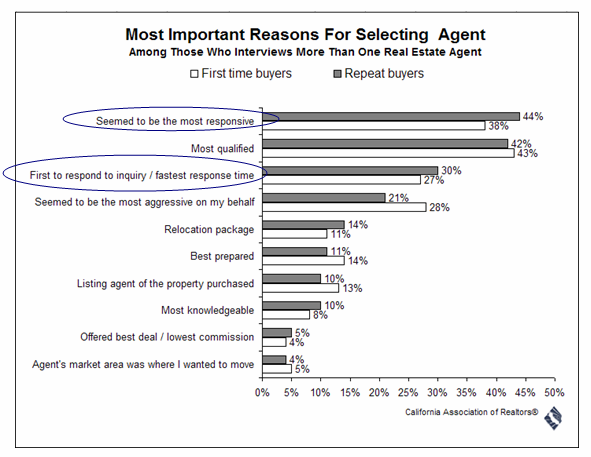
Consumers rate responsiveness as the most important factor in choosing an agent, ahead of qualification, knowledge or commission, according to a CAR (California Association of Realtors) survey published in 2005. Yet, independent industry research published that same year suggests 45 percent of all online inquiries still went unanswered!

Considering that 45 percent of consumers also said they expect agents to get back to them within 30 minutes, there is significant room for brokerages to take advantage of the statistics.

For one, agents are on the road a lot of the time. It’s just part of the business. Many don’t get to their e-mail until the end of the day. Others don’t read their e-mail except once or twice a week. By then, the lead would be long gone. While the computer is a great tool at the office, your team must be able to connect with serious leads as quickly as possible.

While e-mail is not always accessible, unless your agents all carry a Blackberry, they do all carry cell phones. By routing online leads to your agent mobile phones, responsiveness is dramatically increased. And revenue growth follows.

Text messaging works best. It is non intrusive and keeps the agents in control of when and how they respond. They may be with a client at that particular moment, or they may prefer, depending on the opportunity, to respond either by text, e-mail or via telephone. A regular phone call or voice message does not offer the same flexibility.

There are a number of proven wireless lead routing systems on the market today. Considering the importance of responsiveness in the real estate business, the benefits of adopting this technology sooner than later are obvious. What it takes to win is to get to a lead first, and lead routing is an easy way to make this happen. While some brokerages have formal lead response and routing teams, others send inquiries directly to agents, but regardless of the model, brokerages need to ensure inquiries are responded to quickly and, preferably, immediately.

Lastly, brokerages need to recognize that inquiries generated from their listings originate from more sources than just their own website. Vertical search sites and classified websites that listings are syndicated to need to be integrated into their system, to enable text message notification for inquiries, irrespective of the source. This is the only true solution to consolidating the lead management process and optimizing conversion from all the diverse online advertising efforts.


Advanced systems such as the Point2 platform have been able to achieve integration with a number of syndication advertising partners and deliver leads right to the Realtor® cell phones. The initial inquiry is not only sent through email and SMS (text messaging), but the lead information is also added to the Point2 lead capture and profiling part of the platform, for long term incubation and follow through.

Share

Thursday, October 26, 2006

White Paper Part VI

Rich Data

There are a number of appropriate places in this paper to start the discussion on rich data. It drives exposure, lead generation, increases conversion and, better results for home sellers. For our purposes, rich data refers to the publishing of detailed, professional listing information.

Search

Rich data is critical for maximizing traffic as a result of online search. The more descriptive a listing is, the better chance someone will find it online, especially when doing long tail searches. That is, when consumers type detailed search queries into search engines. The better a property is described both in the main copy and the document meta content, the better chance the property will be returned in a search engine result set.

Conversion

Rich data also increases the number of inquiries an online listing generates. In 2005, Alex Perellio of Realogy(formerly Cendant), was quoted at a broker conference saying, “Realtors® are being out marketed today by 10 year old kids selling baseball cards on Ebay.” I may be paraphrasing what Mr. Perellio said, but the essence of the remark remains. You can’t maximize the potential of the Internet as a powerful marketing medium by placing a short paragraph and one shoddy photo of a property worth hundreds of thousands or millions of dollars. Yet, the number of such listings, some even without a single photo, on Realtor.com and other real estate search sites is still astounding.

Part of the problem stems from Realtors® using MLS® data for marketing. The MLS® was never designed for marketing.

The MLS® was first established to facilitate cooperation and to ensure compensation between cooperating brokerages. With the emergence and growth of the Internet in the 90s, MLS content became the de facto standard for online listings display. Today still, it is rarely readable by search crawlers, and online listings documents are rarely descriptive enough to make any significant contribution. Further, the content is insufficient to effectively market properties as ‘homes’ and expect to maximize consumer inquiries and response for the listing Realtor®.

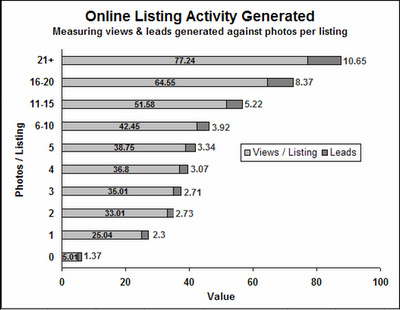
Internal research conducted by Point2 in September of 2006 shows a dramatic increase in page views detailed listings generated and the number of inquiries they yield.

Over 110,000 listings in the Point2 database were examined over a 30 day time frame. The listings were broken down by the number of photos per listing. The results were dramatically consistent. As the number of photos provided for the listing increased, the number of times that listing was viewed also increased, as did the number of leads generated from that listing.

Recent research conducted by LiveDeal.com reinforces the findings generated in the Point2 study. LiveDeal, a consumer real estate search site noticed the listing feeds from Point2 contained far more photos than other feeds. Upon further analysis, Point2 member listings were found to generate almost 300 percent more leads on LiveDeal.com than listings provided by other feed partners.

The message is clear. To maximize Internet leads, Realtors® must start adding a lot of information and photos to their listings.
Accessibility

A highly effective approach to generating sales leads is to provide detailed listing information and useful tools website visitors can access without registration. Consumers today want to remain anonymous, until they are ready to make personal contact with the Realtor®. Once they’ve identified your site as a valuable and helpful destination, they’ll become more receptive to providing personal information. Free home valuations, or unique neighborhood information and statistics can be of interest to thousands of prospects in your area. That’s the value add. Consumers appreciate it, and it works.

Independent market research identifies the top reasons why consumers go to real estate sites. Armed with this knowledge, brokers and agents can easily position themselves to win in their markets.

According to the National Association of Realtors® 2005 Profile of Home Buyers and Sellers report, 95 percent of visitors to real estate websites go there to look for listings.

Within listings, 86 percent of consumers said the most valuable content was photos and descriptions.

Independent research also lists photos as the top reason why consumers go to a real estate website, at 89 percent. The second most important reason is property search, which comes in at a close 81 percent. Mapping takes third place at 77 percent, followed by financing and locating an agent, at 31 percent and 26 percent respectively.

Why is it then that Realtors® often fail to leverage such findings on their websites? Why do many listings often feature a single photo, and often none?

Holding back information is a strategy that no longer works. If consumers can’t get the information they need, on your website, they’ll move on. The strategy of placing a registration on a real estate website to gain IDX access is slowly dying. Sure there will still be some business around for you, but you’ll never know of the opportunities you lost. There are simply too many real estate search sites popping up that provide open access to listings, including major franchise portals like RE/MAX.com.

Listings featured on http://www.point2homes.com/, a website that aggregates listings from tens of thousands of real estate agents indicates that more and more Realtors® are investing time to post a number of photos with their listings and offer to the consumer details that go far beyond the basics of square footage, number of bedrooms and bathrooms. Comments contributed by home sellers about their listings have also started to grow in popularity on the site, further reinforcing the fact that consumers today, be it buyers or sellers want to be more informed and more involved.

Over and above direct access to compelling and useful information, do provide access to one or more important tools, in exchange for an e-mail address. It’s non-threatening. It’s also a very important element of the lead conversion process.

Share

White Paper Part IV - Online Branding

Branding

Traditionally, the best source of advertising for a real estate brokerage is the ‘for sale’ yard sign. It brands the agent and the brokerage in the specific neighborhood. Search sites are now providing a new and similar branding opportunity online through the broker’s listings. Sites like Move.com, Trulia and Point2 Homes provide different branding options for displaying listings. In short, the more sites your listings are posted on, and the more sites they are branded on, the stronger your brand will be online. Considering the shear volume of consumers researching real estate online, branding on the Internet should be just as important to brokerages as offline branding.

Unfortunately, few brokerages are taking full advantage of the different ways they can today brand themselves on the Internet. Service providers offering syndication tools should facilitate the different branding options as well.

Effective online branding can be optimized further by enhancing online exposure for the brokerage website as well as its affiliated agent sites.

There are several common brokerage models in as far as agent websites are concerned:

Centralized Model - Some brokerages choose to operate one website and focus all their marketing efforts on it. Agents affiliated with the company are not permitted to have their own websites. Brokerages that provide their agents with a web page, directory, or 3rd level domain name derived from the main brokerage site fall under this category. The main benefits of this model include the brokerage’s ability to protect and control its online branding, control lead generation and management, and effectively manage its responsiveness in the marketplace.

But these benefits come at a price. The major draw back is that the brokerage ends up losing important search engine visibility advantages. A number of well marketed, interlinked websites that connect the brokerage’s main site with all of its affiliate agent sites is easy to set up and maximizes visibility and exposure on search engines. Such a system optimizes search engine rankings for both the broker site as well its agents’, turning the network into a highly competitive online exposure and lead generation engine that delivers significant, incremental benefits to the entire organization.

In-House Service Provider Model - Some franchises and real estate companies offer agent website solutions that are free standing, and typically not directly linked to the brokerage site. The benefits of this model is that the website solution can be a revenue source for the company, provided development and support costs are manageable. The obvious downside is that few companies invest enough into these technologies to keep their agent solutions on the leading edge. They suffer in their visibility, flexibility and lead handling capabilities.

De-Centralized Model - Other brokerages choose to operate a website of their own but give their agents the option to have their own separate website irrespective of whether they use the same service provider or not. This is the more common model, especially for smaller brokerages. Companies like RE/MAX where agents largely operate as independent contractors also use this model. The main draw back from this model, which is a source of pain for many brokerages we have spoken with is that it does not allow the brokerage to control how its brand is represented online.

On the other hand, some of the benefits this approach delivers is more personal marketing freedom for agents, and linkage between sites, which is valuable for enhancing search engine rankings and exposure for everyone involved.

With this approach being the most popular, many brokerages who deploy this model face more challenges over and above controlling the consistency of their branding online, namely:

1) How to maximize online exposure by leveraging website linkage;
2) How to streamline and manage the lead management process between the brokerage and its affiliate agent sites; and,
3) How to ensure the solution remains ahead of the innovation curve to benefit from its technological advantages as well as its value as a recruitment and retention tool

A proven model is to provide agents with a quality template website solution that gives them personal marketing and positioning flexibility, yet reflects the brokerage’s branding accurately and professionally. When distributed to agents, the sites would link to the brokerage site, right out of the box. The benefits are far reaching and go beyond brand control and natural search optimization. Distributing a strong agent solution is also empowering for the brokerage, as it can be a valuable top talent recruitment and retention tool.

An important footnote is in check at this point. Although providing strong template solutions can be a very sound strategy, there are no easy ways around work that must be done in order for it to be effective. Agents cannot all be provided with websites that feature the same canned content. Each agent must customize their site and add unique, timely and relevant content, in order to optimize search engine positioning for the entire organization. An innovative way to help achieve this goal is to provide agents with websites that incorporate blogging functionality.

Where a template solution may have a few canned pages such as an ‘About the Company’ page, home valuation and home search forms, the focus of the sites should be the agent listings, which are all different and, ideally, blog content.

Blogging not only promotes unique content but also benefits the site from the long tail of search (Broad Search terms) and the linking benefits blogs inherently bring to the mix.

Share

Friday, October 20, 2006

Exposure - Natural Search

Market Fragmentation & Exposure

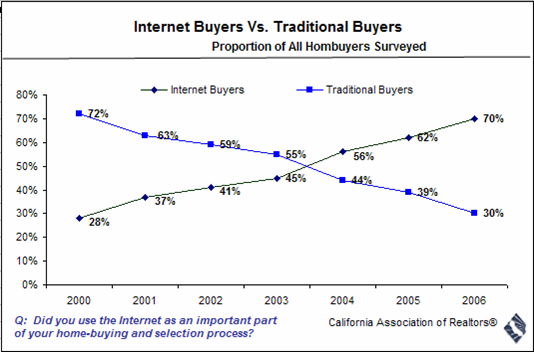
According to the 2006 Internet vs. Traditional Buyers Survey published by the California Association of Realtors (CAR), 9 out of 10 Internet buyers found their agent through a real estate search site. As of 2006, Internet buyers represented 71 percent of total buyers, a 10 percent increase over the previous year.


With numbers this high, increasing online exposure should become a major goal for any real estate brokerage. This section explores four strategies successful brokerages must adopt to win in this area:

· Natural Search optimization;
· Vertical search optimization;
· Offline advertising; and,
· Combined online and offline branding.


As we examine each of the four categories, it is worthwhile to note key differences between natural and vertical search. It’s also important to highlight that both are critical.


Natural search refers to optimizing online content for inclusion in traditional search engines indexes, such as Google, Yahoo, MSN Search and Ask. Vertical search on the other hand involves getting listing content submitted to real estate specific search sites. This generally involves feeding structured data to these sources, wherein natural search involves allowing content to be automatically crawled and indexed by machines.


Natural Search

For years, relevance has been one of the primary goals of major search engines. By most accounts, search engines such as Google have improved the relevance of their search results and their ability to programmatically identify the most appropriate documents for specific search terms. Leading local real estate brokerages are in the best position to take advantage of improvements in search, yet few do. Most brokerages lack the basic search engine optimization knowledge on their team, but more problematic is the abundance of choices of online service providers they can work with, many of whom also lack this basic knowledge.

According to the CAR survey mentioned earlier, of all Internet buyers who found their agent through a real estate search site, 60 percent started their search on an Internet search engine. But, unfortunately, many real estate brokerages have made natural search optimization a non goal. While a company’s position on a search engine is by and large not controllable, there are some fundamental strategies companies should follow to optimize their ranking. This is critical, as it directly relates to lead generation. 63% of Internet buyers started their search on an Internet search engine
- CAR 2006 Internet vs. Traditional Home Buyers Survey


Following are three fundamental strategies real estate companies need to think about with respect to visibility through natural search.

I- Popularity - Search engines quantify a website’s popularity by measuring the number of links it has pointing to it. There are many key algorithmic factors that play into the ultimate placement of a site, but in general, the key is to have as many online articles and blogs point to your website as you possibly can. The better quality these websites and blogs are, the more beneficial and relevant their links become to the search engine. A real estate company can start a program focused on seeking links, but the best long term strategy is to incorporate the company’s URL in all offline and online marketing so anyone seeing it can easily access the site and, in the case of blogs, comment on it. The latter is especially important, given the increasing popularity of blogs.

Blogs are an entire topic to themselves, but for the purpose of this paper, I will briefly go over what they are and why they matter.

Blogs are simple websites or website sections that generally display content in reverse chronological order. Content posted by a blog author is typically open for comments by readers, usually leading to discussion about the content by interested parties. The content can be syndicated to third party blogs and websites through a feed (RSS, Atom, XML). Blogging commands time commitment because in order to be engaging and generate an audience, blog content has to be timely, relevant, and valuable to the readers it targets. The benefits however can be significant. Because of their conversational nature, blogs naturally link to each other, helping to multiply the number of links back to your website, a key part of your ‘‘popularity strategy’ with search engines. An excellent source for a more comprehensive discussion on blogs is the book Naked Conversations, by Robert Scoble and Shel Israel.

II- Content - It is critical for search engine optimization to ensure that your most valuable online content can be easily found and indexed by machines. This refers to property listings. Commonly, real estate companies have websites that display listings via a feed or link from the MLS, and place the listing content inside frames. The most important thing to remember from this section is that content in framesets can not be readily seen and indexed by search engine crawlers. Some framesets launch a listing search in a new window with JavaScript, and some hide the majority of listing content behind a registration. These implementations prevent listing content from being properly crawled.


Let’s consider the example of a brokerage that has over 100 property listings. Each listing represents a minimum of one page of valuable content. Since a website’s position in search engines is enhanced by increasing the amount of content it offers, you can effectively leverage each of your listings by giving each its own web address (URL). And to maximize the value of that page to search engine crawlers, that URL should be descriptive.


III- Web Page Description - The third major strategy for search engine optimization is to accurately describe online documents (pages). Real estate is a local business. Therefore, terms consumer use to search for real estate include local information, such as the general location and neighborhood name. Of course, descriptions need to consider listing types, styles and features. As such, online documents or web pages must accurately describe the content on the page, both in the title and meta information. But they also need to describe the content using commonly used search terms and phrases. Doing both will maximize traffic from common searches as well as from the long tail of search. More on that in a moment.

While identifying popular search terms to apply to your listing descriptions on your site, it is important to be deeply descriptive in order to take advantage of the long tail of search.

The long tail refers to deeper or narrower searches conducted by consumers using search engines to find what they are looking for. As search engines have improved at returning relevant content, many people have become more efficient at using them and are conducting more exact searches to help find exactly what they are looking for, faster.

For comparison, following are some examples of Broad Search and Exact Search terms.

Broad Search:

- San Francisco real estate
- San Francisco homes for sale
- Denver real estate
- Denver homes for sale

Exact Search (typically considered the long tail):

- Nob Hill San Francisco homes for sale
- Homes for sale in Nob Hill San Francisco
- Lakeview Denver homes for sale
- Condos for sale in Lakeview Denver, Colorado

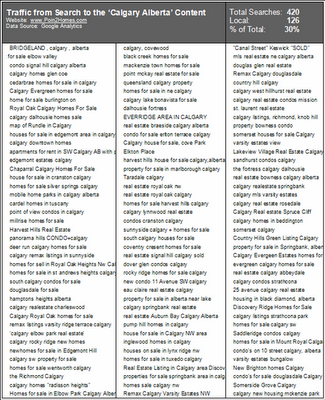
It is important to realize that the long tail of search (Exact Search) has today become extremely relevant, as more consumers are now refining their real estate search queries down to the neighborhood name level, rather than by larger city names. Recent analysis conducted by Point2 Technologies using Google Analytics, on traffic generated to the company’s real estate portal www.Point2Homes.com, showed that some of the busiest market centers are getting anywhere from 15 to 40 percent of their direct traffic from narrow neighborhood searches, such as the examples listed above. Below is a chart of direct traffic to a content section on http://www.point2homes.com/. Over the specified time period that covered a total of 420 searches, 126 or 30 percent of the keyword searches were local neighborhood level search, or, search from the long tail.

If all this sounds like a lot of work, it is. But solutions such as Point2 Agent, Point2 Broker and Point2 Builder are designed to address these requirements, automatically optimizing listings pages for major search engines. The real estate professional needs to merely input listing data on simple web forms, and select structured feature sets. In other words, simply enter your listings and allow the underlying technology to manage search engine optimization for you. Further, the Point2 system gives each listing its own optimized URL, so it can be more easily crawled and indexed by search engines.

Share