Rich Data
There are a number of appropriate places in this paper to start the discussion on rich data. It drives exposure, lead generation, increases conversion and, better results for home sellers. For our purposes, rich data refers to the publishing of detailed, professional listing information.
Search
Rich data is critical for maximizing traffic as a result of online search. The more descriptive a listing is, the better chance someone will find it online, especially when doing long tail searches. That is, when consumers type detailed search queries into search engines. The better a property is described both in the main copy and the document meta content, the better chance the property will be returned in a search engine result set.
Conversion
Rich data also increases the number of inquiries an online listing generates. In 2005, Alex Perellio of Realogy(formerly Cendant), was quoted at a broker conference saying, “Realtors® are being out marketed today by 10 year old kids selling baseball cards on Ebay.” I may be paraphrasing what Mr. Perellio said, but the essence of the remark remains. You can’t maximize the potential of the Internet as a powerful marketing medium by placing a short paragraph and one shoddy photo of a property worth hundreds of thousands or millions of dollars. Yet, the number of such listings, some even without a single photo, on Realtor.com and other real estate search sites is still astounding.
Part of the problem stems from Realtors® using MLS® data for marketing. The MLS® was never designed for marketing.
The MLS® was first established to facilitate cooperation and to ensure compensation between cooperating brokerages. With the emergence and growth of the Internet in the 90s, MLS content became the de facto standard for online listings display. Today still, it is rarely readable by search crawlers, and online listings documents are rarely descriptive enough to make any significant contribution. Further, the content is insufficient to effectively market properties as ‘homes’ and expect to maximize consumer inquiries and response for the listing Realtor®.
Internal research conducted by Point2 in September of 2006 shows a dramatic increase in page views detailed listings generated and the number of inquiries they yield.
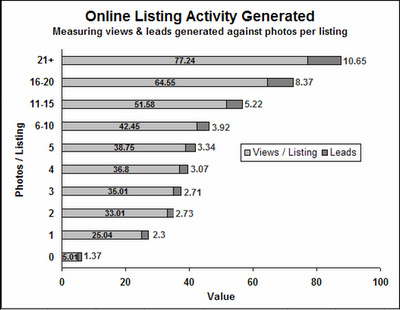
Over 110,000 listings in the Point2 database were examined over a 30 day time frame. The listings were broken down by the number of photos per listing. The results were dramatically consistent. As the number of photos provided for the listing increased, the number of times that listing was viewed also increased, as did the number of leads generated from that listing.
Recent research conducted by LiveDeal.com reinforces the findings generated in the Point2 study. LiveDeal, a consumer real estate search site noticed the listing feeds from Point2 contained far more photos than other feeds. Upon further analysis, Point2 member listings were found to generate almost 300 percent more leads on LiveDeal.com than listings provided by other feed partners.
The message is clear. To maximize Internet leads, Realtors® must start adding a lot of information and photos to their listings.
Accessibility
A highly effective approach to generating sales leads is to provide detailed listing information and useful tools website visitors can access without registration. Consumers today want to remain anonymous, until they are ready to make personal contact with the Realtor®. Once they’ve identified your site as a valuable and helpful destination, they’ll become more receptive to providing personal information. Free home valuations, or unique neighborhood information and statistics can be of interest to thousands of prospects in your area. That’s the value add. Consumers appreciate it, and it works.
Independent market research identifies the top reasons why consumers go to real estate sites. Armed with this knowledge, brokers and agents can easily position themselves to win in their markets.
According to the National Association of Realtors® 2005 Profile of Home Buyers and Sellers report, 95 percent of visitors to real estate websites go there to look for listings.
Within listings, 86 percent of consumers said the most valuable content was photos and descriptions.
Independent research also lists photos as the top reason why consumers go to a real estate website, at 89 percent. The second most important reason is property search, which comes in at a close 81 percent. Mapping takes third place at 77 percent, followed by financing and locating an agent, at 31 percent and 26 percent respectively.
Why is it then that Realtors® often fail to leverage such findings on their websites? Why do many listings often feature a single photo, and often none?
Holding back information is a strategy that no longer works. If consumers can’t get the information they need, on your website, they’ll move on. The strategy of placing a registration on a real estate website to gain IDX access is slowly dying. Sure there will still be some business around for you, but you’ll never know of the opportunities you lost. There are simply too many real estate search sites popping up that provide open access to listings, including major franchise portals like RE/MAX.com.
Listings featured on http://www.point2homes.com/, a website that aggregates listings from tens of thousands of real estate agents indicates that more and more Realtors® are investing time to post a number of photos with their listings and offer to the consumer details that go far beyond the basics of square footage, number of bedrooms and bathrooms. Comments contributed by home sellers about their listings have also started to grow in popularity on the site, further reinforcing the fact that consumers today, be it buyers or sellers want to be more informed and more involved.
Over and above direct access to compelling and useful information, do provide access to one or more important tools, in exchange for an e-mail address. It’s non-threatening. It’s also a very important element of the lead conversion process.
Share


